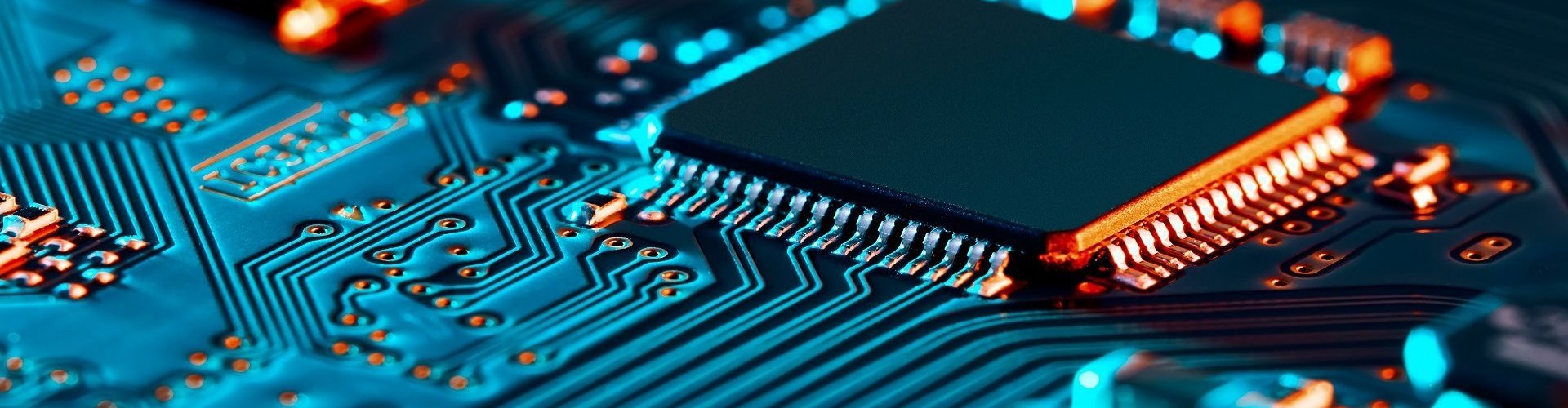
Humanoid Compute Stack
Humanoid robots are evolving from isolated demonstrators into coordinated cobots that work alongside people and alongside each other. Their performance hinges on an integrated semiconductor architecture: AI processors, memory, sensors, actuation electronics, power semiconductors, distributed safety controllers, and wireless communication links enabling collaborative behavior.
AI Brains: Inference System-on-Chips
Humanoids rely on compact inference SoCs built for low-latency real-time perception and whole-body control.
- NPU delivering 50–500 TOPS for vision and policy inference
- GPU/ISP blocks for camera pipelines
- Multicore CPUs for planning and OS/RTOS tasks
- Hardware accelerators for SLAM, depth fusion, and speech
- On-chip safety processors supervising deterministic behaviors
Examples include Tesla custom inference ASICs, Nvidia Jetson Orin, Qualcomm RB-series chips, and Arm-based edge AI SoCs from major Chinese suppliers.
HBM and High-Bandwidth Memory Pipelines
High-resolution vision, multimodal sensors, and transformer-based policies demand substantial memory bandwidth.
Functions include:
- Image buffering
- Spatial mapping
- Policy execution
- Whole-body simulation and stability computation
Compact HBM stacks or LPDDR5X arrays now exceed 100 GB/s, enabling datacenter-grade throughput in sealed mobile platforms.
Sensor Fusion ICs and Perception Silicon
Humanoids integrate dense arrays of perception hardware:
- Vision: stereo, fisheye, global-shutter, event cameras
- Depth: LiDAR, time-of-flight, structured light
- Tactile: fingertip and palm force arrays
- Proprioception: IMUs, joint torque sensors, encoders
- Audio: spatial microphone arrays with beamforming DSPs
Fusion ICs merge these signals into unified state estimates at sub-10 ms cycles. Many subsystems, such as hand joints and fingertips, contain local processing to reduce wiring weight and improve reaction speeds.
Motor Drivers and Actuation Electronics
Precision movement comes from high-performance actuation electronics:
- BLDC servo drivers with field-oriented control
- GaN-based motor controllers
- High-speed current, torque, and position sensing
- Redundant encoders for fault detection
- Safety MCUs enforcing torque and speed limits
Drives may use harmonic, cycloidal, or direct-drive architectures depending on load and compliance requirements.
Power Semiconductors: SiC, GaN, and Energy Flow
Humanoids push compact power electronics to their limits.
Key devices include:
- SiC MOSFETs for high-load joints
- GaN FETs for lightweight DC/DC converters
- Smart power management ICs for distributed power regulation
- High-channel-count BMS ASICs
- Isolation and fault-protection devices for charge safety
Power efficiency directly affects thermal limits, gait speed, lifting ability, and runtime.
AI and LLM Integration for Natural Human Interaction
Cobot environments require intuitive communication. Humanoids embed local or hybrid-cloud language models to support:
- Natural voice commands
- Context grounding for physical tasks
- Vision-language reasoning
- Stepwise task decomposition
- Multi-agent conversational alignment
- Safety-aligned behavioral boundaries
Most deployments use hybrid inference with edge language models for low-latency responses and cloud language models for heavy reasoning.
Thermal Management and Cooling Strategies
Thermal constraints dictate real-world performance.
Common techniques include:
- SoC heat spreaders
- Vapor chambers and micro-heatpipes
- Distributed metallic chassis cooling
- Controlled airflow through micro-fans
- Phase-change materials for burst workloads
- Microcontroller-driven thermal throttling
Unlike vehicles, humanoids lack airflow or large housings, making thermal design one of the hardest challenges in the stack.
Charging and Energy Management
Humanoids require predictable uptime cycles.
Key components include:
- High-power DC charging, typically 300 to 800 watts
- Smart battery management systems for cell-level balancing
- Regenerative braking in joints
- Magnetic or vision-guided docks
- Wireless charging pads in structured environments
- Predictive budgeting across actuators, sensors, and compute
Energy management is a semiconductor discipline. Power management ICs, gallium nitride chargers, and safety relays enforce reliability.
OTA Continuous Learning Loop
Humanoids follow the same closed-loop training cycle pioneered by autonomous vehicles.
- Local perception
- Edge filtering and compression
- Cloud upload of selected episodes
- Training cluster integration for vision, language, policy, and grasping models
- Distillation into compact inference models
- Over-the-air deployment during charge cycles
- Fleet-wide behavioral improvement
This loop enables continuous refinement of perception, stability, manipulation accuracy, dialogue, and safety.
Platooning and Swarming: Humanoid-to-Humanoid Team Intelligence
As humanoids scale into workforce environments, team coordination becomes a critical capability. This is analogous to vehicle-to-vehicle networking for autonomous vehicles, adapted for human-scale manipulation tasks.
Core requirements include:
- Local wireless mesh connectivity using Wi-Fi, ultra-wideband, or industrial 5G
- Shared situational awareness through exchange of compressed vision, depth cues, spatial maps, and task context
- Distributed inference in which each robot runs local policies but shares object locations, motion intent, and predicted paths
- A group planning layer where a supervisor humanoid or coordinating node allocates tasks and synchronizes routes
- Multi-robot manipulation with coordinated motion primitives during shared lifts and cooperative tasks
- Safety alignment where peer robots exchange torque thresholds, balance status, emergency stop events, and proximity warnings
Semiconductor enablers include high-throughput neural processing units, onboard radios with deterministic quality of service, sensor-fusion ICs that timestamp and synchronize shared observations, safety microcontrollers supervising coordinated motion, and low-latency memory pipelines for prediction buffering.
The goal is not just coordination but emergent teamwork. With reliable humanoid-to-humanoid communication, a fleet behaves like a unified system capable of tasks that no single robot can perform alone.
Safety, Security, and Trusted Operation
Humanoids require multilayer safeguards to ensure safe and trustworthy operation:
- Redundant torque and current sensing
- Safety microcontrollers with hard real-time enforcement
- Secure boot chains
- Signed model weights and firmware images
- Tamper-resistant storage for critical code and data
- Motion anomaly detection
- Fail-soft posture routines during errors or power loss
This topic connects naturally to broader artificial intelligence governance and autonomous robotics assurance frameworks, which can be explored in more depth in a dedicated safety and security article.
Why This Stack Matters
Humanoids and autonomous vehicles share a semiconductor backbone, but humanoids operate in dense human spaces where precision, language, perception, energy, and coordinated multi-robot behavior converge. The compute stack determines whether humanoids remain demonstrations or evolve into reliable, scalable, economically viable cobots.